Asset Performance Management and Reliability
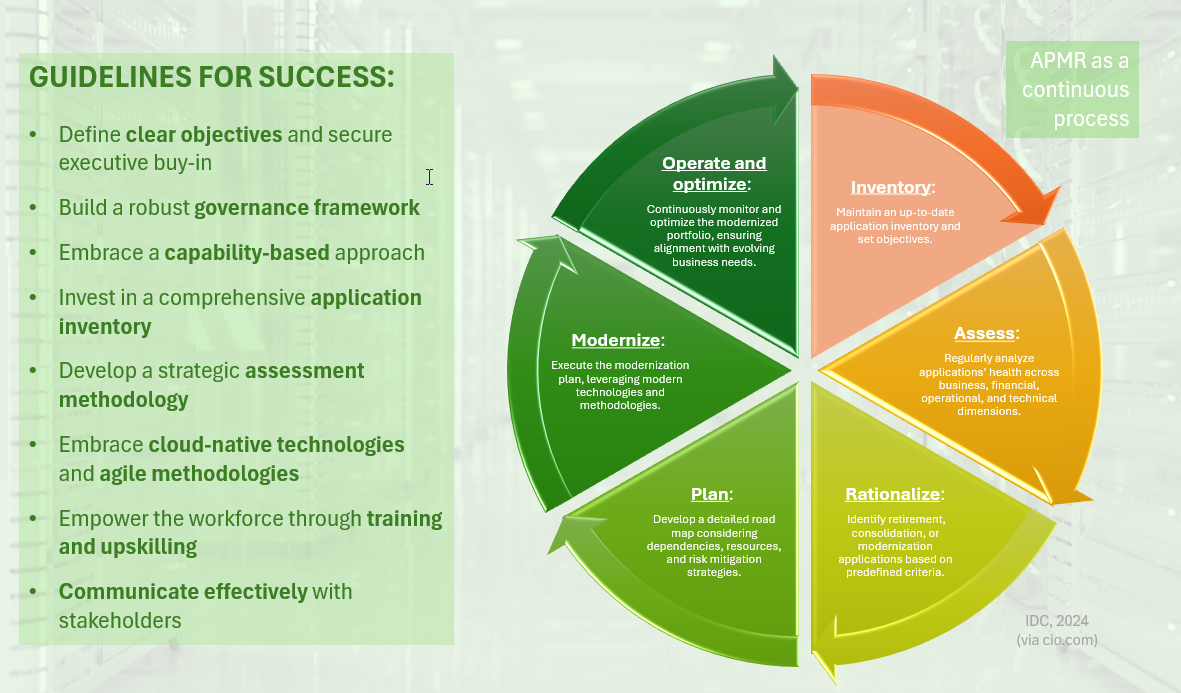
APMR, or Asset Performance Management and Reliability, is a strategic approach used by organizations to maximize the efficiency, reliability, and lifespan of their assets. Implemented as a continuous process, APMR ensures that asset management is not a one-time task but an ongoing cycle of improvement.
Benefits of APMR as a Continuous Process:
Sustainable Operations: Efficient asset management contributes to environmental sustainability by reducing waste and energy consumption.
Increased Asset Reliability: Continuous monitoring and proactive maintenance reduce unexpected failures.
Cost Efficiency: Optimized maintenance scheduling lowers operational costs and extends asset life.
Data-Driven Decisions: Real-time data and analytics support informed decision-making.
Enhanced Safety: Early detection of issues prevents accidents and ensures regulatory compliance.
What’s a quantum computer good for, anyway?
*Cryptography: The most notorious promise of quantum computers has been that they will one day break RSA encryption, a long-standing protocol used worldwide to secure bank transfers, cryptocurrencies and digital communication. That day may come surprisingly soon.
*Fundamental Physics: Simulating interactions of multiple particles rapidly becomes impossible with a classical computer, explains Daniel González-Cuadra, a quantum physicist at the Institute for Theoretical Physics in Austria. “The information that it takes to describe the state of these systems grows exponentially with the size of the system, and at some point you just don’t have enough memory,” he says. Capturing all the complexities requires an equally complex quantum machine.
*Materials Design: The quantum engineering of new molecules could lead to better drugs and to batteries that don’t use costly, environmentally damaging commodities such as rare earth elements. “These things take billions of dollars, so if you just make something even a few percent cheaper or a few percent better, then that’s really worth it,”
*Quantum AI: Indeed, as quantum processors get bigger, some physicists are focusing on using them to boost the performance and energy efficiency of classical artificial intelligence.
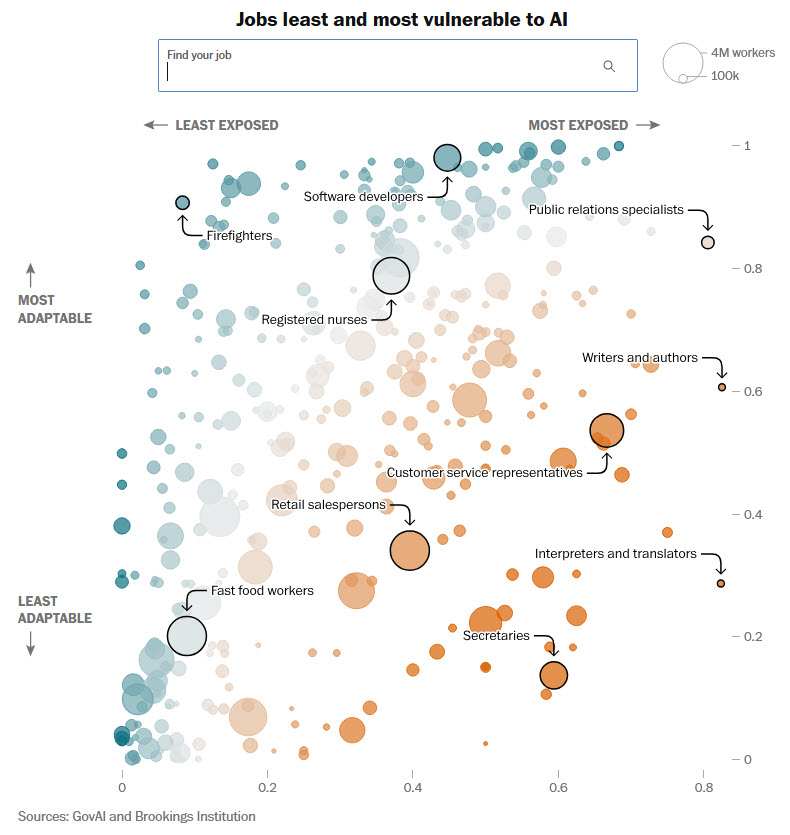
The Jobs Most and Least Susceptible to AI Disruption
No one has a perfect road map to the future, but researchers at GovAI, which studies technology policy, and the Brookings Institution, a Washington think tank, used a novel approach to estimate which workers may be most and least able to adapt to AI.
They concluded that many people most at risk if AI transforms work are also the best placed to find new jobs. You can use the search box and interactive chart above to explore which occupations may have bright prospects and which may not.
But history shows that economists and researchers have been terrible at predicting the effects of new technologies on work and workers, so take forecasts like this one seriously but not literally. Even researchers cranking out studies of AI in workplaces caution that they’re making useful but fallible best guesses.
“All the important questions about AI’s effects on the labor market are still unanswered,” Jed Kolko, a senior fellow at the Peterson Institute for International Economics, recently concluded. Economists at Anthropic, the AI start-up behind the Claude chatbot, stressed the need for “humility” in their analysis of AI seeping into occupations. (Humility is uncommon in Silicon Valley.)